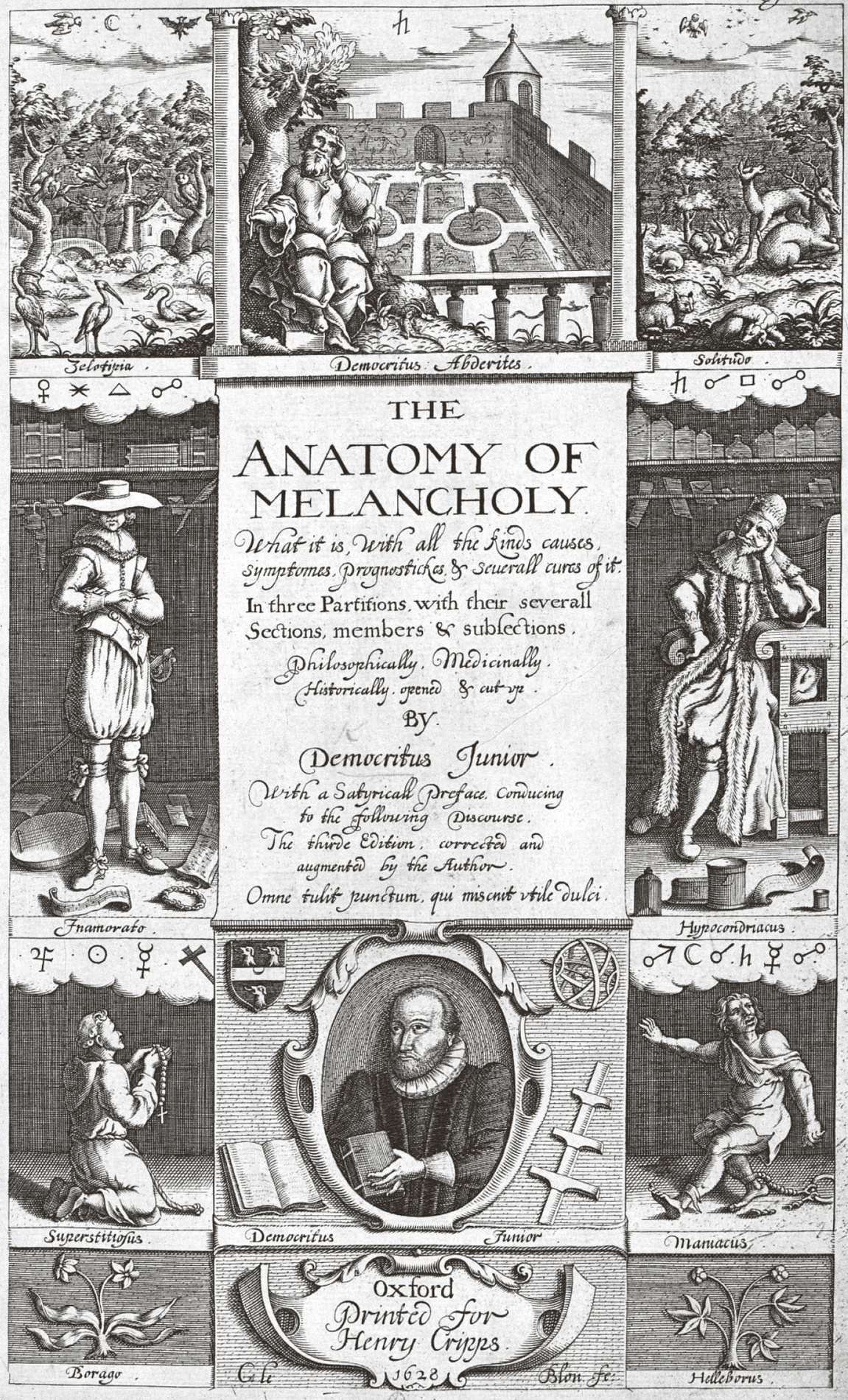
The Anatomy of Melancholy,
What it is. With all the Kinds, Causes, Symptoms, Prognostics, and several Cures of it.
By Democritus Junior.
Democritus Abderites · point at a panel to change
Old Democritus under a tree,
Sits on a stone with book on knee;
About him hang there many features,
Of Cats, Dogs and such like creatures,
Of which he makes Anatomy,
The seat of black choler to see.
Over his head appears the sky,
And Saturn Lord of melancholy.
Zelotypia
To th’ left a landscape of Jealousy,
Presents itself unto thine eye.
A Kingfisher, a Swan, an Hern,
Two fighting Cocks you may discern,
Two roaring Bulls each other hie,
To assault concerning Venery.
Symbols are these; I say no more,
Conceive the rest by that’s afore.
Solitudo
The next of Solitariness,
A portraiture doth well express,
By sleeping dog, cat: Buck and Doe,
Hares, Coneys in the desert go:
Bats, Owls the shady bowers over,
In melancholy darkness hover.
Mark well: If’t be not as’t should be,
Blame the bad Cutter, and not me.
Inamorato
I’th’ under Column there doth stand,
Inamorato with folded hand;
Down hangs his head, terse and polite,
Some ditty sure he doth indite.
His lute and books about him lie,
As symptoms of his vanity.
If this do not enough disclose,
To paint him, take thyself by th’ nose.
Hypocondriacus
Hypocondriacus leans on his arm,
Wind in his side doth him much harm,
And troubles him full sore God knows,
Much pain he hath and many woes.
About him pots and glasses lie,
Newly brought from’s Apothecary.
This Saturn’s aspects signify,
You see them portrayed in the sky.
Superstitiosus
Beneath them kneeling on his knee,
A Superstitious man you see:
He fasts, prays, on his Idol fixt,
Tormented hope and fear betwixt:
For hell perhaps he takes more pain,
Than thou dost Heaven itself to gain.
Alas poor Soul, I pity thee,
What stars incline thee so to be?
Maniacus
But see the Madman rage downright
With furious looks, a ghastly sight.
Naked in chains bound doth he lie,
And roars amain he knows not why?
Observe him; for as in a glass,
Thine angry portraiture it was.
His picture keep still in thy presence;
’Twixt him and thee, there’s no difference.
Borago and Helleborus
Borage and Hellebore fill two scenes,
Sovereign plants to purge the veins
Of melancholy, and cheer the heart,
Of those black fumes which make it smart;
To clear the Brain of misty fogs,
Which dull our senses, and Soul clogs.
The best medicine that ere God made
For this malady, if well assayed.
Democritus Junior
Now last of all to fill a place,
Presented is the Author’s face;
And in that habit which he wears,
His Image to the world appears.
His mind no art can well express,
That by his writings you may guess.
It was not pride, nor yet vainglory,
(Though others do it commonly)
About the book and this reader
“The best book ever written.” — Nicholas Lezard
“This is one of the indispensable books; for my money, it is the best of all.” — Philip Pullman
“The only book that ever took him out of bed two hours sooner than he wished to rise.” — James Boswell, on Samuel Johnson
“The Anatomy of Melancholy is, by a magnificent and somehow very English irony, one of the great comic works of the world.” — Anthony Burgess
“The most amusing and instructive medley of quotations and classical anecdotes I ever perused.” — Lord Byron
“…the tone of a tirade that, in the midst of its fury, smiles at itself.” — William H. Gass
“His manner is to shroud and carry off his feelings under a cloud of learned words.” — Charles Lamb
“A medical treatise, the greatest indeed written by a layman.” — Sir William Osler
“An excellent book… wherein he hath piled up variety of much excellent learning.” — Thomas Fuller
The Book In 1621, an Oxford scholar calling himself Democritus Junior set out to anatomize sadness—and ended up writing about everything: love, stars, diet, ghosts, and the cure of sorrow. Robert Burton’s book is hilarious, tender, and notoriously hard to finish, thick with Latin, Greek, and archaic allusions.
The Reader This edition keeps his prose unbroken without changing a word: every foreign passage translated beside the text, cryptic shorthand (“Hor.,” “Consil. 23.”) spelled out with his authors identified, and explanatory notes sitting quietly in the margin alongside Burton’s own.
Burton read everything. Now you can read him.
Key Latin Greek translations § citation Name who / side peek a Burton’s note note · word notes & glosses term definition
How a page looks
Burton, 3.2.3.1 point at the marked words, or tap them
… but fear and sorrow may justly challenge the chief place. Though Hercules de Saxonia§ will exclude fear from Love-Melancholy, yet I am otherwise persuaded.e Res est solliciti plena timoris amor. ’Tis full of fear, anxiety, doubt, care, peevishness, suspicion, it turns a man into a woman, which made HesiodHesiod 775 BC–700 BC Hesiod was an early Greek poet, usually dated to around 700 BC, from Ascra in Boeotia. His surviving poems are the Works and Days and the Theogony. On a reading page, click a name to open it in Side Peek. belike, put fear and paleness Venus’ daughters …
e OvidOvid 42 BC – AD 17 Publius Ovidius Naso (43 BC–AD 17 or 18) was a Roman poet from Sulmo. Augustus exiled him to Tomis on the Black Sea. His works include the Metamorphoses, the Fasti, the love poems (Amores, Ars Amatoria, Remedia Amoris) and the Tristia, written in exile. On a reading page, click a name to open it in Side Peek..
Love’s a thing full of anxious fears g
Ercole Sassonia (Hercules de Saxonia), chapter 3
belike — It is likely or probably; perhaps w
Page & Type
Languages & Citations
Margins & Reading Comfort
Key to the colours and signs
Languages
- Latin
- Greek
- Middle English
- Italian, French …
Burton’s notes & header
- a his words, beside the red rule
- Author trans. his own English for his Latin
- ° a note Gowland left out, restored
- { 1.1.1.1 at top left: where you stand in Burton’s outline
Added by this edition
- translation in its language’s colour, on a dotted line
- § § a reference or Bible verse, written out
- Name point for who; click on a page for Side Peek
- term click dotted terms inside notes for humoral/apothecary definitions
- ¶ at a paragraph’s edge: copy a citation link
- word obsolete-word glosses; note source Gowland’s notes
Who made it
- g Gowland (2021)
- dj Dell & Jordan-Smith (1927)
- w Webster’s dictionary (1913)
- kjv the King James Bible
- dm Democritus Minor’s edition (19th century)
A page at random; take it as counsel
Synopses
- IThe First Partition
- In diseases consider Sect. 1 Memb. 1. to 1.1.1
- Their Causes. Subsect. 1. to 1.1.1.1
- Impulsive;
- sin, concupiscence, &c.
- Instrumental;
- intemperance, all second causes, &c.
Or
Definition, Member, Division, Subsect. 2. to 1.1.1.2- Of the body 300, which are
- Epidemical; as Plague, Plica, &c.
Or
Particular; as Gout, Dropsy, &c.
Or
of the head or mind. Subsect. 3. to 1.1.1.3- In disposition; as all perturbations, evil affection, &c.
Or
Habits, as Subsect. 4. to 1.1.1.4- Dotage.
- Frenzy.
- Madness.
- Ecstasy.
- Lycanthropia.
- Chorus sancti Viti.
- Hydrophobia.
- Possession or obsession of Devils.
- Melancholy. See go to the branch marked ♈
- ♈Melancholy: in which consider
- Its Equivocations, in Disposition, Improper, &c., Subsect. 5. to 1.1.1.5
- Memb. 2. To its explication, a digression of anatomy, in which observe parts of Subsect. 1. to 1.1.2
- Body hath parts Subsect. 2. to 1.1.2.2
- Contained as
- Humours, 4, Blood, Phlegm, &c.
- Spirits; vital, natural, animal.
or
containing- Similar; spermatical, or flesh, bones, nerves, &c., Subsect. 3. to 1.1.2.3
- Dissimilar; brain, heart, liver, &c., Subsect. 4. to 1.1.2.4
Or
Soul and his faculties, as- Vegetal. Subsect. 5. to 1.1.2.5
- Memb. 3. Its definition, name, difference, Subsect. 1. to 1.1.3
- The part and parties, affected, affection, &c., Subsect. 2. to 1.1.3.2
- The matter of melancholy, natural, unnatural, &c., Subsect. 3. to 1.1.3.3
- Species, or kinds, which are Subsect. 4. to 1.1.3.4
- Proper to parts, as
- Of the head alone, Hypochondriacal, or windy melancholy. Of the whole body* Edition’s note: The image sets three species here in one brace (of the head alone; hypochondriacal, or windy; of the whole body); the hidden table gives them as one paragraph, which is kept whole.
- with their several causes, symptoms, prognostics, cures.
Or
Indefinite; as Love-melancholy, the subject of the third partition.
- Its Causes in general. Sect. 2, go to the branch marked A. to 1.2
- Its Symptoms or signs. Sect. 3, go to the branch marked B. to 1.3
- Its prognostics or indications. Sect. 4, go to the branch marked C. to 1.4
- Its Cures; the subject of the second Partition.
- General, as Memb. 1. to 1.2.1
- Supernatural
- As from God immediately, or by second causes, Subsect. 1. to 1.2.1.1
- Or from the devil immediately, with a digression of the nature of spirits and devils, Subsect. 2. to 1.2.1.2
- Or mediately by Magicians, Witches, Subsect. 3. to 1.2.1.3
Or
Natural- Primary as stars, proved by Aphorisms, signs from Physiognomy, Metoposcopy, Chiromancy, Subsect. 4. to 1.2.1.4
or
Secondary, as- Congenite, inward from
- Old age, temperament, Subsect. 5. to 1.2.1.5
- Parents, it being an hereditary disease, Subsect. 6. to 1.2.1.6
Or
Outward, or adventitious, which are- Evident, outward, remote, adventitious, as
- Necessary, see go to the branch marked ♉
- Not necessary, as Memb. 4 Sect. 2. to 1.2.4
- Nurses, Subsect. 1. to 1.2.4.1
- Education, Subsect. 2. to 1.2.4.2
- Terrors, affrights, Subsect. 3. to 1.2.4.3
- Scoffs, calumnies, bitter jests, Subsect. 4. to 1.2.4.4
- Loss of liberty, servitude, imprisonment, Subsect. 5. to 1.2.4.5
- Poverty and want, Subsect. 6. to 1.2.4.6
- An heap of other accidents, death of friends, loss, &c., Subsect. 7. to 1.2.4.7
Or
Continent, inward, antecedent, nearest. Memb. 5 Sect. 2. to 1.2.5- In which the body works on the mind, and this malady is caused by precedent diseases; as agues, pox, &c., or temperature innate, Subsect. 1. to 1.2.5.1
- Or by particular parts distempered, as brain, heart, spleen, liver, Mesentery, Pylorus, stomach, &c., Subsect. 2. to 1.2.5.2
- Particular to the three species. See go to the branch marked ♊
- Of head-Melancholy are, Subsect. 3. to 1.2.5.3
- Inward
- Innate humour, or from distemperature adust.
- A hot brain, corrupted blood in the brain.
- Excess of Venery, or defect.
- Agues, or some precedent disease.
- Fumes arising from the stomach, &c.
Or
Outward- Heat of the Sun immoderate.
- A blow on the head.
- Overmuch use of hot wines, spices, garlic, onions, hot baths, overmuch waking, &c.
- Idleness, solitariness, or overmuch study, vehement labour, &c.
- Passions, perturbations, &c.
- Of hypochondriacal, or windy melancholy are, Subsect. 4. to 1.2.5.4
- Inward
- Default of spleen, belly, bowels, stomach, mesentery, meseraic veins, liver, &c.
- Months, or haemorrhoids stopped, or any other ordinary evacuation.
Or
Outward- Those six non-natural things abused.
- Over all the body are, Subsect. 5. to 1.2.5.5
- Inward
- Liver distempered, stopped, overhot, apt to engender melancholy, temperature innate.
Or
Outward- Bad diet, suppression of haemorrhoids, &c., and such evacuations, passions, cares, &c., those six non-natural things abused.
- Diet offending in, Subsect. 1. to 1.2.2.1
- Substance
- Bread; coarse and black, &c.
- Drink; thick, thin, sour, &c.
- Water unclean, milk, oil, vinegar, wine, spices, &c.
- Flesh
- Parts; heads, feet, entrails, fat, bacon, blood, &c.
- Kinds
- Beef, Pork, Venison, Hares, Goats, Pigeons, Peacocks, Fen-fowl, &c.
- Herbs, Fish, &c.
- Of fish; all shell-fish, hard and slimy fish, &c.
- Of herbs; pulse, cabbage, melons, garlic, onions, &c.
- All roots, raw fruits, hard and windy meats.
- Quality, as in
- Preparing, dressing, sharp sauces, salt meats, indurate, soused, fried, broiled, or made dishes, &c.
- Quantity
- Disorder in eating, immoderate eating, or at unseasonable times, &c., Subsect. 2. to 1.2.2.2
- Custom; delight, appetite, altered, &c., Subsect. 3. to 1.2.2.3
- Retention and evacuation, Subsect. 4. to 1.2.2.4
- Costiveness, hot baths, sweating, issues stopped, Venus in excess, or in defect, phlebotomy, purging, &c.
- Air; hot, cold, tempestuous, dark, thick, foggy, moorish, &c., Subsect. 5. to 1.2.2.5
- Exercise, Subsect. 6. to 1.2.2.6
- Unseasonable, excessive, or defective of body or mind, solitariness, idleness, a life out of action, &c.
- Sleep and waking, unseasonable, inordinate, overmuch, over-little, &c., Subsect. 7. to 1.2.2.7
- Memb. 3 Sect. 2. Passions and perturbations of the mind, Subsect. 1. With a digression of the force of imagination, Subsect. 2, and division of passions into Subsect. 3. to 1.2.3 to 1.2.3.2 to 1.2.3.3
- Irascible
- Sorrow, cause and symptom, Subsect. 4. Fear, cause and symptom, Subsect. 5. Shame, repulse, disgrace, &c., Subsect. 6. Envy and malice, Subsect. 7. Emulation, hatred, faction, desire of revenge, Subsect. 8. Anger a cause, Subsect. 9. Discontents, cares, miseries, &c., Subsect. 10. to 1.2.3.4 to 1.2.3.5 to 1.2.3.6 to 1.2.3.7 to 1.2.3.8 to 1.2.3.9 to 1.2.3.10
Or
concupiscible- Vehement desires, ambition, Subsect. 11. Covetousness, Φιλαργυρία, Subsect. 12. Love of pleasures, gaming in excess, &c., Subsect. 13. Desire of praise, pride, vainglory, &c., Subsect. 14. Love of learning, study in excess, with a digression of the misery of Scholars, and why the Muses are melancholy, Subsect. 15. to 1.2.3.11 to 1.2.3.12 to 1.2.3.13 to 1.2.3.14 to 1.2.3.15
- General, as of Memb. 1. to 1.3.1
- Body, as ill digestion, crudity, wind, dry brains, hard belly, thick blood, much waking, heaviness and palpitation of heart, leaping in many places, &c., Subsect. 1. to 1.3.1.1
or
Mind- Common to all or most
- Fear and sorrow without a just cause, suspicion, jealousy, discontent, solitariness, irksomeness, continual cogitations, restless thoughts, vain imaginations, &c., Subsect. 2. to 1.3.1.2
Or
- Celestial influences, as ♄ ♃ ♂, &c., parts of the body, heart, brain, liver, spleen, stomach, &c.
- Humours
- Sanguine are merry still, laughing, pleasant, meditating on plays, women, music, &c.
- Phlegmatic, slothful, dull, heavy, &c.
- Choleric, furious, impatient, subject to hear and see strange apparitions, &c.
- Black, solitary, sad, they think they are bewitched, dead, &c.
- Or mixed of these four humours adust, or not adust, infinitely varied.
- Their several customs, conditions, inclinations, discipline, &c.
- Ambitious thinks himself a King, a Lord; covetous runs on his money, lascivious on his mistress; religious hath revelations, visions, is a Prophet, or troubled in mind, a scholar on his book, &c.
- Continuance of time, as the humour is intended or remitted, &c.
- Pleasant at first, hardly discerned, afterwards harsh and intolerable if inveterate.
- Hence some make three degrees,
- 1. Falsa cogitatio.
- 2. Cogitata loqui.
- 3. Exequi loquutum.
- By fits, or continuate, as the object varies, pleasing or displeasing.
- Simple, or as it is mixed with other diseases, Apoplexies, Gout, Caninus appetitus, &c., so the symptoms are various.
- Particular to the three distinct species. See go to the branch marked ♋ Memb. 2. to 1.3.2
- Head-melancholy. Subsect. 1. to 1.3.2.1
- In body
- Headache, binding, heaviness, vertigo, lightness, singing of the ears, much waking, fixed eyes, high colour, red eyes, hard belly, dry body, no great sign of melancholy in the other parts.
Or
In mind- Continual fear, sorrow, suspicion, discontent, superfluous cares, solicitude, anxiety, perpetual cogitation of such toys they are possessed with, thoughts like dreams, &c.
- Hypochondriacal or windy melancholy. Subsect. 2. to 1.3.2.2
- In body
- Wind, rumbling in the guts, belly-ache, heat in the bowels, convulsions, crudities, short wind, sour and sharp belchings, cold sweat, pain in the left side, suffocation, palpitation, heaviness of the heart, singing in the ears, much spittle, and moist, &c.
Or
In mind- Fearful, sad, suspicious, discontent, anxiety, &c. Lascivious by reason of much wind, troublesome dreams, affected by fits, &c.
- Over all the body. Subsect. 3. to 1.3.2.3
- In body
- Black, most part lean, broad veins, gross, thick blood, their haemorrhoids commonly stopped, &c.
Or
In mind- Fearful, sad, solitary, hate light, averse from company, fearful dreams, &c.
- Symptoms of Nuns’, Maids’, and widows’ melancholy, in body and mind, &c., Subsect. 4. to 1.3.2.4
- A reason of these symptoms. Memb. 3. to 1.3.3
- Why they are so fearful, sad, suspicious without a cause, why solitary, why melancholy men are witty, why they suppose they hear and see strange voices, visions, apparitions.
- Why they prophesy, and speak strange languages, whence comes their crudity, rumbling, convulsions, cold sweat, heaviness of heart, palpitation, cardiaca, fearful dreams, much waking, prodigious fantasies.
- Tending to good, as
- Morphew, Scabs, Itch, Breaking out, &c.
- Black Jaundice.
- If the Haemorrhoids voluntarily open.
- If varices appear.
- Tending to evil, as
- Leanness, dryness, hollow-eyed, &c.
- Inveterate melancholy is incurable.
- If cold, it degenerates often into Epilepsy, Apoplexy, dotage, or into blindness.
- If hot, into madness, despair, and violent death.
- Corollaries and questions.
- The grievousness of this above all other diseases.
- The diseases of the mind are more grievous than those of the body.
- Whether it be lawful in this case of melancholy, for a man to offer violence to himself. Neg.
- How a melancholy or mad man offering violence to himself, is to be censured.
- IIThe Second Partition
- Cure of melancholy is either
- Sect. 1. General to all, which contains to 2.1
- Unlawful means forbidden
- Memb.1. From the Devil, Magicians, Witches, &c., by charms, spells, incantations, Images, &c. to 2.1.1
- Quaest. 1. Whether they can cure this, or other such-like diseases?
- Quaest. 2. Whether if they can so cure, it be lawful to seek to them for help?
or
Lawful means, which are- 2. Immediately from God, a Jove principium, by prayer, &c. to 2.1.2
- 3. Quaest. 1. Whether Saints and their Relics can help this infirmity? to 2.1.3
- Quaest. 2. Whether it be lawful in this case to sue to them for aid?
or
4. Mediately by Nature, which concerns and works by to 2.1.4- 2. Patient, in whom is required obedience, constancy, willingness, patience, confidence, bounty, &c., not to practise on himself. to 2.1.4.2
- 3. Physic, which consists of to 2.1.4.3
- Dietetical go to the branch marked ♈
- Pharmaceutical go to the branch marked ♉
- Chirurgical go to the branch marked ♊
or
Particular to the three distinct species go to the branch marked ♋ go to the branch marked ♌ go to the branch marked ♍
- ♈Sect. 2. Dietetical, which consists in reforming those six non-natural things, as in to 2.2
- Diet rectified 1st Memb. to 2.2.1
- Such meats as are easy of digestion, well dressed, hot, sod, &c., young, moist, of good nourishment, &c.
- Bread of pure wheat, well baked.
- Water clear from the fountain.
- Wine and drink not too strong, &c.
- Flesh
- Mountain birds, partridge, pheasant, quails, &c.
- Hen, capon, mutton, veal, kid, rabbit, &c.
- Fish
- That live in gravelly waters, as pike, perch, trout, Sea-fish, solid, white, &c.
- Herbs
- Borage, bugloss, balm, succory, endive, violets, in broth, not raw, &c.
- Fruits & roots
- Raisins of the Sun, apples corrected for wind, oranges, &c., parsnips, potatoes, &c.
or
2nd. Quantity. to 2.2.1.2- At seasonable and usual times of repast, in good order, not before the first be concoted, sparing, not overmuch of one dish.
- 2nd. Rectification of Retention and Evacuation, as costiveness, Venery, bleeding at nose, months stopped, baths, &c. to 2.2.2
- 3rd. Air rectified, with a Digression of the Air. to 2.2.3
- Naturally in the choice, and site of our country, dwelling-place, to be hot and moist, light, wholesome, pleasant, &c.
- Artificially, by often change of air, avoiding winds, fogs, tempests, opening windows, perfumes, &c.
- 4th. Exercise. to 2.2.4
- Of body and mind, but moderate, as hawking, hunting, riding, shooting, bowling, fishing, fowling, walking in fair fields, galleries, tennis, bars.
- Of mind, as Chess, cards, tables, &c., to see plays, masques, &c., serious studies, business, all honest recreations.
- 5th. Rectification of waking and terrible dreams, &c. to 2.2.5
- 6th. Rectification of passions and perturbations of the mind. go to the branch marked ♎ to 2.2.6
- From himself
- Avoiding all occasions of his infirmity.
- Not giving way to passions, but resisting to his utmost.
or
from his friends- 2. By fair and foul means, counsel, comfort, good persuasion, witty devices, fictions, and if it be possible to satisfy his mind. to 2.2.6.2
- 3. Music of all sorts aptly applied. to 2.2.6.3
- 4. Mirth, and merry company. to 2.2.6.4
- Sect. 3. A consolatory digression, containing remedies to all discontents and passions of the mind. to 2.3
- 2. Particular discontents, as deformity of body, sickness, baseness of birth, &c. to 2.3.2
- 3. Poverty and want, such calamities and adversities. to 2.3.3
- 4. Against servitude, loss of liberty, imprisonment, banishment, &c. to 2.3.4
- 5. Against vain fears, sorrows for death of friends, or otherwise. to 2.3.5
- 6. Against envy, livor, hatred, malice, emulation, ambition, and self-love, &c. to 2.3.6
- 7. Against repulses, abuses, injuries, contempts, disgraces, contumelies, slanders and scoffs, &c. to 2.3.7
- 8. Against all other grievous and ordinary symptoms of this disease of melancholy. to 2.3.8
- ♉Sect. 4. Pharmaceutice, or Physic which cureth with medicines, with a digression of this kind of Physic, is either Memb. 1 Subsect. 1. to 2.4
- General to all
- Alterative
- Simples altering melancholy, with a digression of Exotic Simples, 2nd Subsect. to 2.4.1.2
- Herbs, 3rd Subsect. to 2.4.1.3
- To the heart; borage, bugloss, Scorzonera, &c.
- To the head; balm, hops, nenuphar, &c.
- Liver; Eupatory, artemisia, &c.
- Stomach; wormwood, centaury, pennyroyal.
- Spleen; Ceterach, ash, Tamarisk.
- To purify the blood; endive, succory, &c.
- Against wind; origan, fennel, aniseed, &c.
- 4th. Subsect. Precious stones; as smaragds, chelidonies, &c. Minerals, as gold, &c. to 2.4.1.4
or
Compounds altering melancholy, with a digression of Compounds, 5th Subsect. to 2.4.1.5- Inwardly taken
- Liquid
- fluid
- Wines; as of Hellebore, Bugloss, Tamarisk, &c.
- Syrups of borage, bugloss, hops, Epithyme, endive, succory, &c.
or
consisting- Conserves of violets, maidenhair, borage, bugloss, roses, &c.
- Confections; Treacle, Mithridate, Eclegmes or Linctures.
or
solid, as those aromatical confections.- hot
- Diambra, dianthus.
- Diamargaritum calidum.
- Diamoschum dulce.
- Electuarium de gemmis.
- Laetificans Galeni & Rhasis.
or
cold- Diamargaritum frigidum.
- Diarrhodon Abbatis.
- Diacorolli, diacodion, with their tables.
- Condites of all sorts, &c.
or
Outwardly used, as- Oils of Camomile, Violets, Roses, &c.
- Ointments; alablastritum, populeum, &c.
- Liniments; plasters, cerotes, cataplasms, frontals, fomentations, Epithems, sacks, bags, odoraments, posies, &c.
or
Purging go to the branch marked ☾
or
Particular to the three distinct Species, go to the branch marked ♋ go to the branch marked ♌ go to the branch marked ♍.
- Simples purging melancholy.
- 1st Subsect. Upward as vomits to 2.4.2.1
- Asarabacca, Laurel, white Hellebore, Scilla, or Sea onion, Antimony, Tobacco.
or
Downward, 2nd Subsect. to 2.4.2.2- More gentle; as Senna, Epithyme, Polypody, Myrobalans, Fumitory, &c.
- Stronger; Aloes, lapis Armenus, lapis lazuli, black hellebore.
or
3rd Subsect. Compounds purging melancholy. to 2.4.2.3- Superior parts.
- Mouth
- swallowed, or
- Liquid, as Potions, Juleps, Syrups, wine of Hellebore, bugloss, &c.
- Solid, as lapis Armenus, & lazuli, pills of Indy, pills of Fumitory, &c.
- Electuaries, Diasenna, confection of Hamech, Hieralogodion, &c.
- Not swallowed, as gargarisms, masticatories, &c.* Edition’s note: Its "or" is printed as part of the vertical "swallowed, or" above it, so no separate connector.
or
Nostrils; sneezing-powders, odoraments, perfumes, &c.
or
Inferior parts, as Clysters strong and weak, and suppositories of Castilian soap, honey boiled, &c.
- ♊Chirurgical physic, which consists of Memb. 3. to 2.4.3
- Phlebotomy, to all parts almost, and all the distinct Species.
- With knife, horse-leeches.
- Cupping-glasses.
- Cauteries, and searing with hot Irons, boring.
- Dropax and Sinapismus.
- Issues to several parts, and upon several occasions.
- ♋Sect. 5. Cure of head-melancholy. Memb. 1. to 2.5
- Good Air.
- Sleep more than ordinary.
- Excrements daily to be avoided by Art or Nature.
- Exercise of body and mind not too violent, or too remiss, passions of the mind, and perturbations to be avoided.
- 2nd. Bloodletting if there be need, or that the blood be corrupt, in the arm, forehead, &c., or with Cupping-glasses. to 2.5.1.2
- 3rd. Preparatives and purgers. to 2.5.1.3
- Preparatives; as Syrup of borage, bugloss, Epithyme, hops, with their distilled waters, &c.
- Purgers; as Montanus’, & Matthiolus’ Helleborismus, Quercetanus’ Syrup of Hellebore, Extract of Hellebore, Pulvis Hali, Antimony prepared, Rulandi aqua mirabilis: which are used, if gentler medicines will not take place, with Arnaldus’ vinum buglossatum, Senna, cassia, myrobalans, aurum potabile, or before Hamech, Pil. Indae, Hiera. Pil. de lap. Armeno, lazuli.
- 4th. Averters. to 2.5.1.4
- Cardan’s nettles, frictions, clysters, suppositories, sneezings, masticatories, nasals, cupping-glasses.
- To open the Haemorrhoids with horse-leeches, to apply horse-leeches to the forehead without scarification, to the shoulders, thighs.
- Issues, boring, cauteries, hot irons in the suture of the crown.
- 5th. Cordials, resolvers, hinderers. to 2.5.1.5* Edition’s note: The brace runs on to the next sheet (pg430_01), where five more items stand without a head (Odoraments of Roses ... Baths of sweet water). They are read as the rest of this list, the outward cordials: they sit in the column of these children, before "6th." and outside its brace.
- A cup of wine or strong drink.
- Bezoar’s stone, amber, spice.
- Conserves of Borage, Bugloss, Roses, Fumitory.
- Confection of Alkermes.
- Electuarium laetificans Galeni & Rhasis, &c.
- Diamargaritum frig., Diaboraginatum, &c.
- Odoraments of Roses, Violets.
- Irrigations of the head, with the decoctions of nymphaea, lettuce, mallows, &c.
- Epithems, ointments, bags to the heart.
- Fomentations of oil for the Belly.
- Baths of sweet water, in which were sod mallows, violets, roses, Water lilies, Borage flowers, ram’s heads, &c.
- 6th. Correctors of accidents, as, to 2.5.1.6
- To procure sleep, and are
- Inwardly taken,
- Simples,
- Poppy, Nymphaea, lettuce, roses, purslane, henbane, mandrake, nightshade, opium, &c.
or
Compounds.- Liquid, as Syrups of Poppy, Verbasco, Violets, Roses.
- Solid, as requies Nicholai, Philonium Romanum, Laudanum Paracelsi.
or
Outwardly used, as,- Oils of Nymphaea, Poppy, Violets, Roses, Mandrake, Nutmegs.
- Odoraments of Vinegar, rose water, opium.
- Frontals of rose cake, rose vinegar, nutmeg.
- Ointments, alablastritum, unguentum populeum, simple or mixed with opium.
- Irrigations of the head, feet, sponges, Music, murmur and noise of waters.
- Frictions of the head and outward parts, sacculi of Henbane, wormwood at his pillow, &c.
- Against terrible dreams; not to sup late, or eat pease, cabbage, venison, meats heavy of digestion, use of balm, hart’s-tongue, &c.
- Against ruddiness and blushing, inward and outward remedies.
- Diet, preparatives, purgers, averters, cordials, correctors, as before.
- Phlebotomy in this kind more necessary, and more frequent.
- To correct and cleanse the blood with Fumitory, Sene, Succory, Dandelion, Endive, &c.
- Diet, preparatives, averters, cordials, purgers, as before, saving that they must not be so vehement.
- Use of pennyroyal, wormwood, centaury sod, which alone hath cured many.
- To provoke urine with aniseed, daucus, asarum, &c., and stools if need be by clysters and suppositories.
- To respect the spleen, stomach, liver, hypochondries.
- To use Treacle now and then in winter.
- To vomit after meals sometimes, if it be inveterate.
- Subsect. 2. To expel wind to 2.5.3.2
- Inwardly taken
- Simples,
- Roots, Herbs, Spices, Seeds,* Edition’s note: Printed vertically as "Roots, Herbs, Spices, Seeds," with one small brace for each word; the hidden table gives the four words as one paragraph, which is kept whole, so the four lists hang from it in that order.
- Galanga, gentian, Enula, Angelica, Calamus Aromaticus, zedoary, china, condite ginger, &c.
- Pennyroyal, rue, calamint, bay-leaves, & berries, Scordium, Betony, Lavender, camomile, centaury, wormwood, cumin, broom, orange pills.
- Saffron, cinnamon, mace, nutmeg, pepper, musk, zedoary with wine, &c.
- Aniseed, fennel-seed, ammi, cary, cumin, nettle, bays, parsley, grana paradisi.
or
Compounds, as- Dianisum, Diagalanga, Diaciminum, diacalaminthes, Electuarium de baccis Lauri, Benedicta laxativa, &c., pulvis Carminativus, & pulvis descrip. Antidotario Florentino, aromaticum rosatum, Mithridat.
or
Outwardly used, as Cupping-glasses to the Hypochondries without scarification, oil of camomile, rue, aniseed, their decoctions, &c.
- IIIThe Third Partition
- Love and Love-Melancholy, Memb. 1 Sect. 1. to 3.1.1
- Preface or Introduction. Subsect. 1. to 3.1.1.1
- Love’s definition, Pedigree, Object, Fair, Amiable, Gracious and pleasant, from which comes Beauty, Grace, which all desire and love, parts affected.
- Division or kinds Subsect. 2. to 3.1.1.2
- Natural, in things without life, as love and hatred of elements; and with life, as vegetal, vine and elm, sympathy, antipathy, &c.
- Sensible, as of Beasts, for pleasure, preservation of kind, mutual agreement, custom, bringing up together, &c.
or
Rational.- Simple which hath 3 objects, as Memb. 2. to 3.1.2
- Profitable. Subsect. 1. to 3.1.2.1
- Health, wealth, honour, we love our benefactors: nothing so amiable as profit, or that which hath a show of commodity.
- Pleasant. Subsect. 2. to 3.1.2.2
- Things without life, made by art, pictures, sports, games, sensible objects, as hawks, hounds, horses. Or men themselves for similitude of manners, natural affection, as to friends, children, kinsmen, &c., for glory, such as commend us.
- Of women, as
- Before marriage, as Heroical Mel., Sect. 2, vide go to the branch marked ♈ to 3.2
- Or after marriage, as Jealousy, Sect. 3, vide go to the branch marked ♉ to 3.3
- Honest. Subsect. 3. to 3.1.2.3
- Fucate in show, by some error or hypocrisy; some seem and are not; or truly for virtue, honesty, good parts, learning, eloquence, &c.
or
Mixed of all three which extends to Memb. 3. to 3.1.3- Common good, our neighbour, country, friends, which is charity; the defect of which is cause of much discontent and Melancholy.
or
God, Sect. 4. to 3.4- In excess, vide go to the branch marked ♊
- In defect, vide go to the branch marked ♋
- Memb. 1.His pedigree, power, extent to vegetals and sensible creatures, as well as men, to spirits, devils, &c. to 3.2.1
- His name, definition, object, part affected, tyranny.
- Causes Memb. 2. to 3.2.2
- Stars, temperature, full diet, place, country, clime, condition, idleness. Subsect. 1. to 3.2.2.1
- Natural allurements, and causes of love, as beauty, its praise, how it allureth. Comeliness, grace, resulting from the whole, or some parts, as face, eyes, hair, hands, &c., Subsect. 2. to 3.2.2.2
- Artificial allurements, and provocations of lust and love, gestures, apparel, dowry, money, &c.
- Quaest. Whether beauty owe more to Art or Nature? Subsect. 3. to 3.2.2.3
- Opportunity of time and place, conference, discourse, music, singing, dancing, amorous tales, lascivious objects, familiarity, gifts, promises, &c., Subsect. 4. to 3.2.2.4
- Bawds and Philtres. Subsect. 5. to 3.2.2.5
- Symptoms or signs Memb. 3. to 3.2.3
- Of Body
- Dryness, paleness, leanness, waking, sighing, &c.
- Quaest. An detur pulsus amatorius?
or
Of Mind- Bad, as
- Fear, sorrow, suspicion, anxiety, &c.
- An hell, torment, fire, blindness, &c.
- Dotage, slavery, neglect of business.
or
Good, as- Spruceness, neatness, courage, aptness to learn music, singing, dancing, poetry, &c.
- Prognostics; Despair, Madness, Frenzy, Death, Memb. 4. to 3.2.4
- Cures Memb. 5. to 3.2.5
- By labour, diet, Physic, abstinence, Subsect. 1. to 3.2.5.1
- To withstand the beginnings, avoid occasions, fair and foul means, change of place, contrary passion, witty inventions, discommend the former, bring in another, Subsect. 2. to 3.2.5.2
- By good counsel, persuasion, from future miseries, inconveniences, &c., Subsect. 3. to 3.2.5.3
- By Philtres, magical, and poetical cures, Subsect. 4, to let them have their desire disputed pro and con. Impediments removed, reasons for it, Subsect. 5. to 3.2.5.4 to 3.2.5.5
- ♉Jealousy. Sect. 3. to 3.3
- His name, definition, extent, power, tyranny, Memb. 1. to 3.3.1
- Division, Equivocations, kinds. Subsect. 1. to 3.3.1.1
- Improper
- To many beasts; as Swans, Cocks, Bulls.
- To Kings and Princes, of their subjects, successors.
- To friends, parents, tutors over their children, or otherwise.
or
Proper- Before marriage, corrivals, &c.
- After, as in this place our present subject.
- Causes Subsect. 2. to 3.3.1.2
- In the parties themselves,
- Idleness, impotency in one party, melancholy, long absence.
- They have been naught themselves. Hard usage, unkindness, wantonness, Inequality of years, persons, fortunes, &c.
or
From others- Outward enticements and provocations of others.
- Symptoms, Memb. 2. to 3.3.2
- Fear, sorrow, suspicion, anguish of mind, strange actions, gestures, looks, speeches, locking up, outrages, severe laws, prodigious trials, &c.
- Prognostics Memb. 3. to 3.3.3
- Despair, madness, to make away themselves, and others.
- Cures Memb. 4. to 3.3.4
- By avoiding occasions, always busy, never to be idle.
- By good counsel, advice of friends, to contemn or dissemble it. Subsect. 1. to 3.3.4.1
- By prevention before marriage. Plato’s communion.
- To marry such as are equal in years, birth, fortunes, beauty, of like conditions, &c. Of a good family, good education. To use them well. Subsect. 2. to 3.3.4.2
- ♊Religious melancholy. Sect. 4. to 3.4
- In excess of such as do, that which is not required. Memb. 1. to 3.4.1
- A proof that there is such a species of Melancholy, Name, Object God, what his beauty is, how it allureth, Part and parties affected, superstitious, Idolaters, Prophets, Heretics, &c., Subsect. 1. to 3.4.1.1
- Causes Subsect. 2. to 3.4.1.2
- From others
- The devil’s allurements, false miracles, Priests for their gain. Politicians to keep men in obedience, Bad instructors, blind Guides.
Or
from themselves- Simplicity, fear, ignorance, solitariness, Melancholy, curiosity, pride, vainglory, decayed Image of God.
- Symptoms Subsect. 3. to 3.4.1.3
- General
- Zeal without knowledge, obstinacy, superstition, strange devotion, stupidity, confidence, stiff defence of their tenets, mutual love & hate of other sects, belief of incredibilities, impossibilities.
Or
Particular.- Of Heretics, pride, contumacy, contempt of others, wilfulness, vainglory, singularity, prodigious paradoxes.
- In superstitious, blind zeal, obedience, strange works, fasting, sacrifices, oblations, prayers, vows, pseudo-martyrdom, mad and ridiculous customs, ceremonies, observations.
- In Pseudoprophets, visions, revelations, dreams, prophecies, new doctrines, &c., of Jews, Gentiles, Mahometans, &c.
- Prognostics. Subsect. 4. to 3.4.1.4
- New doctrines, paradoxes, blasphemies, madness, stupidity, despair, damnation.
- Cures, Subsect. 5. to 3.4.1.5
- By Physic if need be, conference, good counsel, persuasion, compulsion, correction, punishment. Quaeritur an cogi debent? Affir.
- Secure, void of grace and fears.
- Epicures, Atheists, Magicians, Hypocrites, such as have cauterized consciences, or else are in a reprobate sense, worldly secure, some Philosophers, impenitent sinners. Subsect. 1. to 3.4.2.1
Or
Distrustful, or too timorous, as desperate. In despair consider, Subsect. 2. to 3.4.2.2- His definition, Equivocations, part and parties affected. Subsect. 2. to 3.4.2.2
- Causes Subsect. 3. to 3.4.2.3
- The devil and his allurements, Rigid Preachers, that wound their consciences, Melancholy, contemplation, solitariness. How melancholy & despair differ. Distrust, weakness of faith. Guilty conscience for offence committed; misunderstanding Scriptures.
- Symptoms Subsect. 4. to 3.4.2.4
- Fear, sorrow, anguish of mind, extreme tortures and horror of conscience, fearful dreams, conceits, visions, &c.
- Prognostics; Blasphemy, violent death. Subsect. 5. to 3.4.2.5
- Cures Subsect. 6. to 3.4.2.6
- Physic as occasion serves, conference, not to be idle or alone. Good counsel, good company, all comforts & contents, &c.
Florilegium
Celebrated passages
- Democritus Junior to the Reader ~199 minBurton’s playful self-portrait and satirical utopia — the great doorway into the whole book.
- A Digression of the Air ~68 minAn imaginary flight over earth and heavens weighing climates, winds, and stars.
- Symptoms of Love-Melancholy ~89 minPale looks, sighs, sleeplessness, poetry, and lovers’ contradictions.
See moreSee less
- The Author’s Abstract of Melancholy ~3 minA poem alternating the sweets and damps of melancholy before the prose begins.
- A Digression of the Nature of Spirits ~41 minHow seventeenth-century demonology accounts for spirits, witches, and despair.
- Digression of the Misery of Scholars ~47 minWhy the Muses are melancholy: patrons, poverty, neglect, and the scholar’s lot.
- Exercise Rectified of Body and Mind ~55 minWalks, chess, gardens, studies, and honest recreations prescribed against sadness.
- Music a Remedy ~7 minHow song and instruments calm troubled spirits and draw melancholy out.
- A Consolatory Digression ~13 minPhilosophical remedies for poverty, exile, grief, and every worldly reverse.
- Heroical Love: Pedigree, Power, and Extent ~17 minLove as the supreme madness running through the Third Partition.
- Jealousy ~13 minHow suspicion feeds upon love across nations, households, and imaginations.
- Religious Melancholy ~26 minFalse zeal, superstition, despair, and the closing counsel: be not solitary, be not idle.